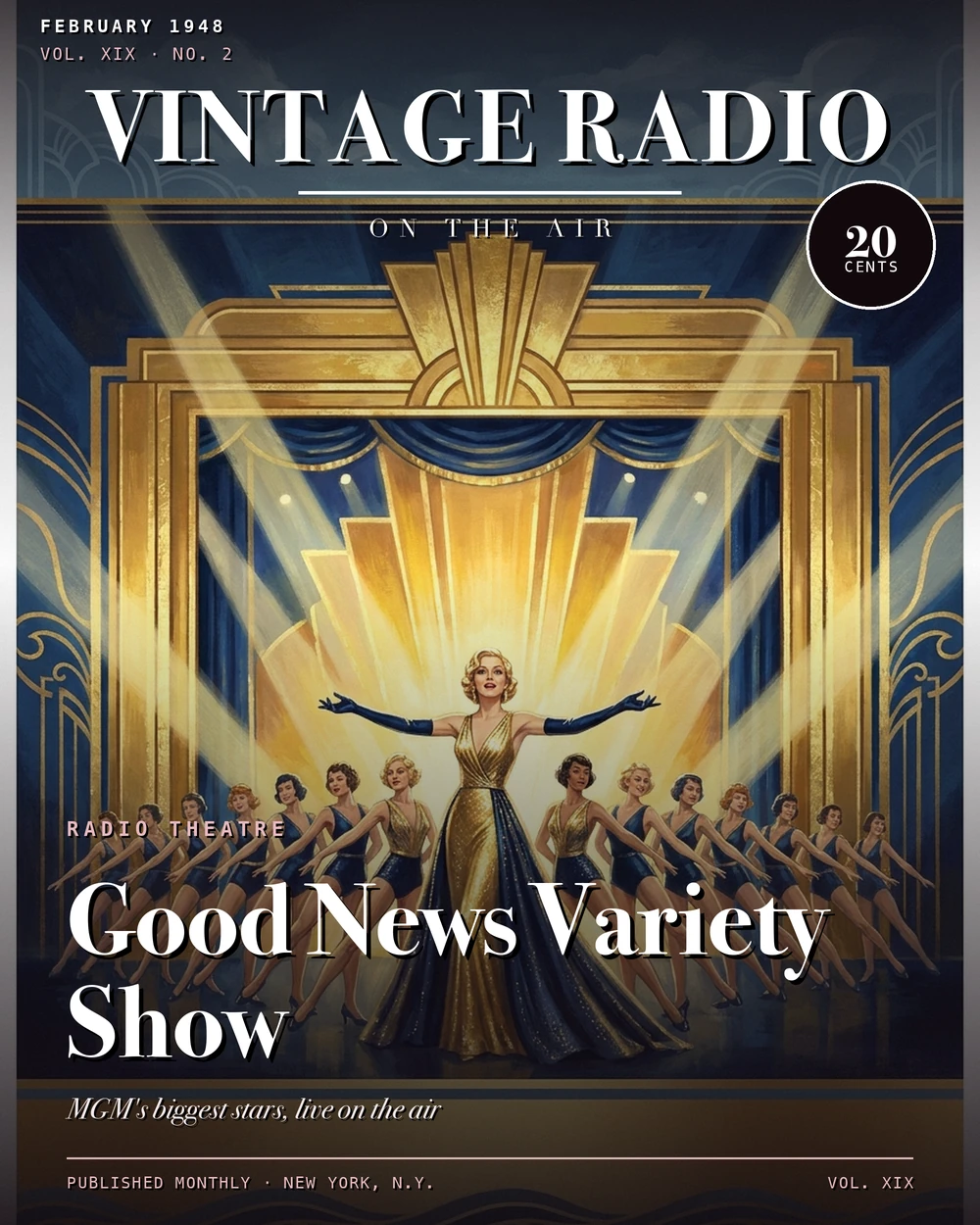
Good News Variety Show
Hollywood Comes to Radio
The Good News Variety Show was built on a premise that had never been tried before: a major Hollywood film studio and a national radio network joining forces to sell a product for a commercial sponsor. When it premiered on November 4, 1937 — not the early 1940s, as later accounts sometimes claimed — the show was a genuinely new kind of arrangement. MGM studio chief Louis B. Mayer pitched the concept to General Foods and its Benton & Bowles advertising agency after working through earlier title ideas like "Film Stars On Parade" and "Film Stars In Review." The result aired on NBC at a production cost of $25,000 per week, described at the time as the largest studio-sponsor partnership of its kind. Maxwell House coffee was the sponsor, and the show's identity reflected both halves of that partnership — it also went out under the names "Hollywood Good News" and "The Maxwell House MGM Hour."
The show's title and theme came from the 1927 Broadway musical Good News, with music and lyrics by Ray Henderson, Buddy DeSylva, and Lew Brown. MGM had already turned that musical into a film in 1930, so the title carried a familiar ring. Each season the broadcast updated its name — Good News of 1938, then Good News of 1939, then Good News of 1940 — before closing its run in July 1940 under the name Maxwell House Coffee Time. The surviving episode catalog runs from late December 1937 through February 1, 1940, representing 25 known broadcasts.
The Launch and the People Behind It
The first broadcast was staged at Hollywood's El Capitan Theater on November 4, 1937, presented with the full ceremony of a movie premiere — searchlights outside, roughly 1,500 invited guests inside. That opening episode featured scenes from the MGM film The Firefly with Allan Jones and Jeanette MacDonald reprising their roles for radio. It was an immediate statement of what the show intended to be: not a dramatization of films already in theaters, but advance previews of upcoming MGM releases, giving radio listeners a taste of what was coming before it arrived on screen.
Producer Bill Bacher, director Ed Gardner, and musical director Meredith Willson — who led an MGM chorus and orchestra — shaped the production from the inside. Warren Hull and Ted Pearson handled announcing duties. A recording held by the Paley Center for Media credits writers Sam Moore and Phil Rapp alongside Bacher and Willson, with Robert Young as host and Fanny Brice alongside Frank Morgan and Hanley Stafford in the regular cast.
The Hosts, the Stars, and the Format
The show rotated through four hosts over its run. James Stewart opened the series and held the role into early 1938; Robert Taylor succeeded him in the first half of that year, Robert Young took over in the fall of 1938, and Dick Powell closed things out in 1940. The roster of MGM contract players who passed through was substantial — Judy Garland, Joan Crawford, Mickey Rooney, Spencer Tracy, Clark Gable, and Myrna Loy among them — and the surviving episode titles show just how wide the guest pool ran, with Virginia Bruce, Freddie Bartholomew, Eddie Cantor, Tony Martin, Jessica Dragonette, and Lucille Ball all turning up.
Each episode blended comedy routines, musical numbers, and host segments. A feature called "Backstage at the Movies" offered simulated conversations set inside stars' dressing rooms and MGM executive boardroom meetings, giving the show a distinctive inside-Hollywood quality that set it apart from a standard variety hour. On May 19, 1938, Joan Crawford opened a new segment called "MGM Theater of the Air," performing a dramatic interlude titled "Dark World." The show's ambitions kept expanding as it settled into its run.
Frank Morgan appeared regularly in a comedy role throughout the series. Fanny Brice and Hanley Stafford performed their Baby Snooks characters — Brice first joined on the fourth episode, November 25, 1937, and the pairing remained a fixture of the show. After the series ended, both Morgan and Brice carried on in the successor program Maxwell House Coffee Time, which gave each a separate 15-minute segment within a 30-minute broadcast.
The December 1937 Episodes
The episode dated December 23, 1937 — the earliest date appearing in the catalog record — was titled "Guest Rosalie" and featured Nelson Eddy, Eleanor Powell, Ray Bolger, and Ilona Massey from the MGM musical Rosalie, backed by Meredith Willson's orchestra. That was the advance-preview model in action: Rosalie opened in theaters that same month. Another catalog entry, "Guest Reginald Owen," connects to the same film — Owen had appeared in Rosalie as the Chancellor. The episode "Dedicated to Jeanette MacDonald" and the listing of "Guests Allan Jones and Mary Martin" trace back to the show's earliest broadcasts and its use of The Firefly cast, though the Allan Jones and Mary Martin pairing also hints at the way guests from overlapping MGM productions moved through the lineup across the season.
How the First Season Landed
The show finished its first season, 1937–38, with a 16.6 average Hooper rating, placing 11th nationally — a solid number for a new program entering a competitive landscape. It had established itself clearly enough to continue into a second and then third season, cycling through updated titles each year while the core format stayed intact.
The run ended July 25, 1940. By that point the program had worked through four hosts, dozens of major MGM names, and three seasons of weekly production. The successor show Maxwell House Coffee Time kept some of the same talent — particularly Morgan and Brice — on the air for audiences who had followed the Good News format since 1937. The show's claim to a particular place in radio history rests on that original structure: the first time a major film studio, a national network, and a commercial sponsor built a weekly program together from the ground up.